5 minute Read
Can India sustain the infrastructure behind its AI ambitions?
India’s AI ambitions are creating a significant infrastructure opportunity. For investors, however, the key question is how durable political support for that growth will remain as its economic, environmental and social costs become more apparent.
India has emerged as one of the world’s most enthusiastic adopters of artificial intelligence. It is now OpenAI’s second-largest market by users after the US, while attracting AI investment has become a key part of the Modi government’s economic agenda.
But that enthusiasm carries a difficult trade-off. India’s vast IT and business-services workforce is increasingly exposed to the same technology the government is promoting, with automation beginning to change the number and types of jobs the sector creates. Against a backdrop of high youth unemployment, the question is becoming more pressing: how far can India accelerate its AI ambitions without undermining one of its most important sources of employment?
India’s AI ambition
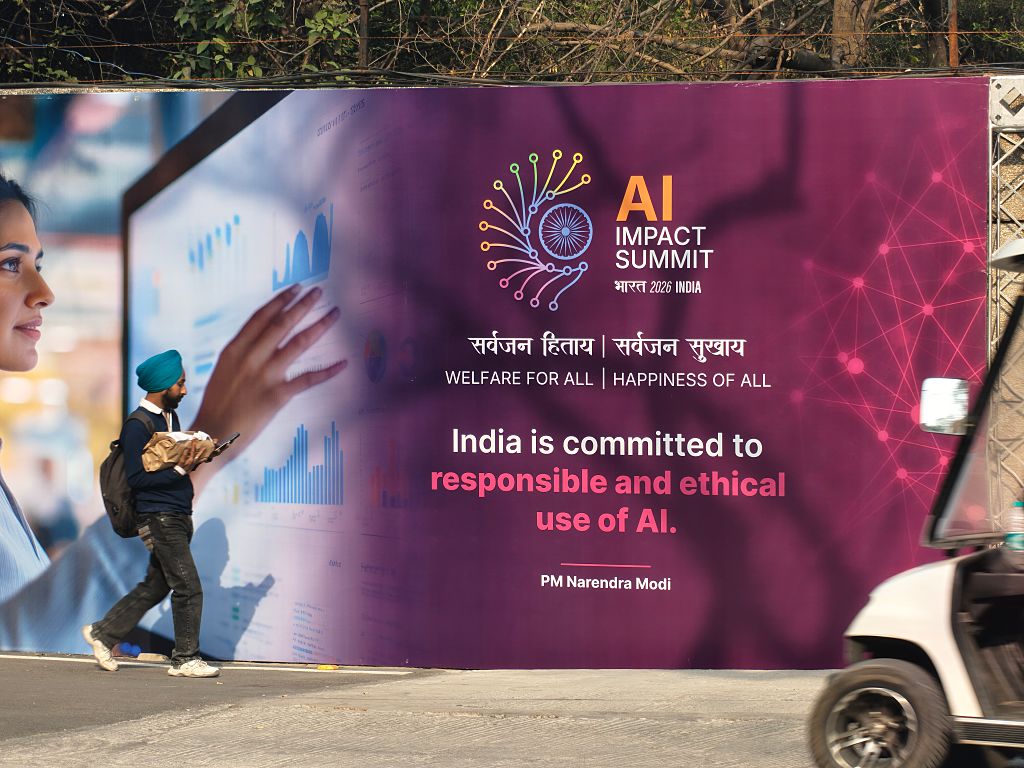
Earlier in 2026, India used the high-profile AI Impact Summit in New Delhi to make its ambitions clear. With OpenAI’s Sam Altman, Google’s Sundar Pichai and Anthropic’s Dario Amodei in attendance, the message was simple: India wants a bigger role in shaping the global AI economy.
That ambition is increasingly being backed by domestic capability. Bengaluru-based Sarvam unveiled two homegrown AI models, trained on Indian languages and data, and is among 12 companies receiving government support to develop indigenous foundation models. The strategy is therefore twofold: attract global AI investment while building the technology and expertise to compete at home.
The infrastructure behind the boom
Reflecting this appetite, India is seeing a sharp surge in data-centre investment. According to a 2026 quarterly report by Savills India, real estate-focused private equity inflows into the country rose 33 percent year on year, with data centres accounting for 38 percent of the total — making them the largest single segment of real estate investment. The trend has been reinforced by the government’s February 2026 announcement of tax breaks for global cloud services providers using Indian data centres until early 2047.
That capital is translating quickly into new capacity. India’s installed data-centre capacity has risen from around 375 MW in 2020 to approximately 1,575 MW today, according to Firstpost. Among the most significant projects in the pipeline is Google’s planned AI hub in Andhra Pradesh, being developed in partnership with the Adani Group. The Tarluvada project is reportedly valued at USD 15 billion and is expected to become Google’s largest investment of its kind outside the US, underscoring both the scale of India’s infrastructure build-out and the intensity of competition among global AI companies.
However, India’s national AI ambitions will not produce an even infrastructure build-out. Land, power, water and planning decisions are largely shaped at state level, where governments differ markedly in their capacity to deliver infrastructure and their willingness to offer incentives. Competition for investment is already encouraging some states to provide bespoke concessions: Andhra Pradesh, for example, has allowed the Google-linked project to operate as its own electricity distributor within the development, giving it greater control over how it procures and manages power. Such arrangements can accelerate individual projects, but they also risk creating a patchwork in which data-centre growth is concentrated in states prepared to offer the most favourable terms. For investors, the question is not only what incentives are available today, but whether they will remain politically acceptable as pressure on state finances, electricity networks and local resources increases.
The political cost of disruption
India’s rapid embrace of AI carries a particular economic risk. The country’s IT services industry has been one of the main engines of middle-class growth and upward mobility since the 1990s, absorbing generations of young, educated workers into relatively well-paid jobs. Yet it is precisely this workforce that is now among the most exposed to AI-driven automation. The Financial Times has reported that major IT companies including Infosys and Wipro have reduced staffing by 5-6 percent from 2023 levels, as weaker demand, earlier over-hiring and increasing automation reshape how services are delivered.
This matters in a country already struggling to generate enough high-quality jobs for its young population. Unemployment among 25–29 year-olds is now close to 20 percent, according to the BBC. The risk is therefore not simply that AI displaces existing workers, but that it weakens one of the traditional routes into the middle class just as millions of young Indians are entering the labour market.
This creates a growing tension for the government. New Delhi wants to accelerate AI adoption, attract investment and build domestic capabilities, but it also faces pressure to demonstrate that technological growth will translate into jobs and economic opportunity. That pressure was visible in July 2026, when large numbers of young Indians joined demonstrations in New Delhi led by the satirical Cockroach Janta Party. Although initially driven by anger over the education system and alleged examination irregularities, the protests also reflected broader concerns about jobs and economic prospects.
For investors, the question is therefore not simply whether the government supports AI today. It is how durable that support will remain if AI becomes increasingly associated with job losses, weaker graduate employment and declining opportunities for upward mobility, particularly as India moves towards the 2029 general election.
Competing for critical resources
Employment is only one side of the challenge. India’s data centre boom is also running up against a more basic constraint: access to power and water. The pressure is particularly acute for water. As the BBC noted in 2025, citing the World Bank, India has 18 percent of the world’s population but only 4 percent of its water resources. Many planned data centres are also concentrated around major urban clusters, where competition for those resources is already intense.
Power presents a parallel challenge. AI-focused data centres require exceptionally large, reliable and continuous electricity supplies, potentially adding significant demand to already constrained state grids. Developers may seek direct access to renewable generation, but this can require new transmission infrastructure and storage capacity, while backup generation or reliance on India’s coal-heavy grid could complicate corporate emissions commitments. The question is therefore not simply whether India can generate enough electricity, but whether individual states can deliver it at the required location, reliability and price.
These pressures are beginning to surface politically and legally. Climate activists and local residents have challenged new developments, while Firstpost has reported at least four legal petitions against Google’s planned Andhra Pradesh data centre project. Litigation around major infrastructure projects is common in India, but if opposition to data centres gains momentum, access to water and power, planning approvals and community acceptance could become meaningful constraints on the pace and location of future development.
What should investors be watching?
India is unlikely to abandon its AI ambitions. The greater risk is that implementation becomes more uneven, politicised and locally contested as the costs become clearer. Investors should therefore distinguish between strong national support for AI and the practical durability of individual projects. Over the life of an investment, access to power and water, the stability of state-level concessions, and the ability to demonstrate tangible local benefits may matter as much as demand for computing capacity.